Today, shop bells ring and voices chatter in Fort Collins’ vibrant Old Town, but 120 years ago this was simply the town. In these same buildings, underneath today’s bustle, the voices of the past echo.
One voice belonged to Chinese immigrant Hong Sing. Part of a known handful of Asian immigrants in early Fort Collins, Hong operated one of the longest-owned Chinese businesses, a laundry, from approximately 1898-1920. His story reflects the difficulties of the Chinese living in America during the early 1900s.

Hong Sing’s Laundry c.1920. Archive at Fort Collins Museum of Discovery, H05552.
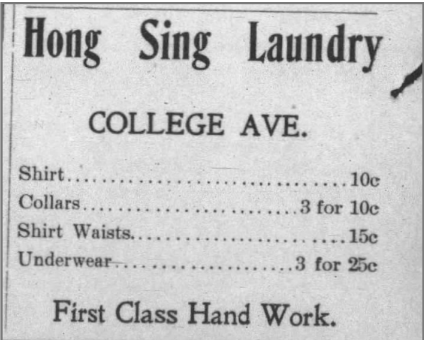
The Larimer County Independent, June 22, 1899. P.8. Accessed on newspapers.com
In the mid-1800s, Chinese immigration soared during the gold rush and railroad-building era, but economic tension and racism lead to increasing anti-Chinese views and violence. In 1882, Congress unanimously passed the Chinese Exclusion Act, barring most Chinese from immigrating to America and prohibiting all Chinese in America from gaining citizenship (it was not repealed until 1943). Laundries, one of a few jobs white workers didn’t want, became a way for Chinese Americans to support themselves.
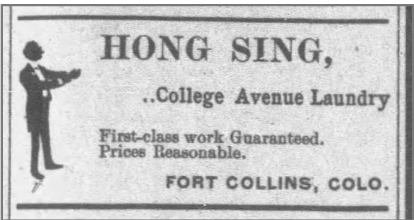
The Fort Collins Express and The Fort Collins Review, February 11th, 1899. P.4. Accessed on newspapers.com
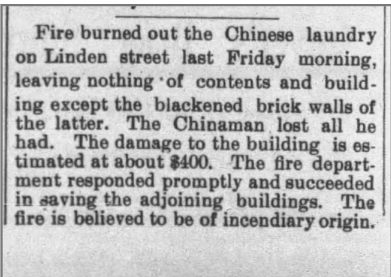
The Larimer County Independent, October 10th, 1901. P.3. Accessed on newspapers.com
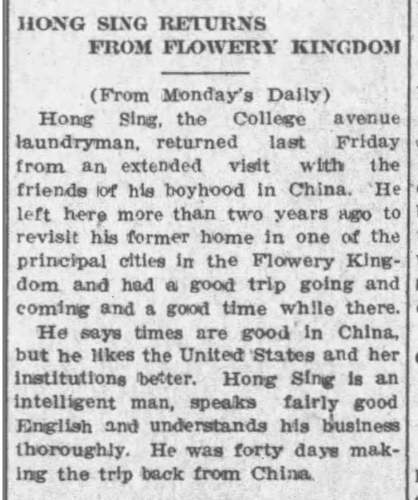
The Larimer County Independent, January 12th, 1911. P.2. Accessed on newspapers.com
Like most of Fort Collins, Hong’s business relied on water piped from the Poudre River. But even with easier access to water, Hong’s work was still long and difficult, and he would never be fully accepted. While the lives of his white neighbors were often reported in the paper, Hong is rarely mentioned, and when he is, his name is often misspelled or accompanied by racist nicknames.
Though held on the margins, Hong was generally known and liked. In 1904 when he was sued after a man tried to take laundry without a claim ticket, the local jury sided with Hong. But anti-Asian sentiment extended to Fort Collins. After this incident someone turned Hong and Lee in to a Federal officer in charge of deporting, “aliens who have become paupers.” Ignoring the fact that Hong operated a successful business, they were taken to Denver and charged with entering the country under “false pretenses.” The duo were only saved from deportation when a local Judge appealed their case, vouching for their work.
Hong knew firsthand one’s position as an Asian American in the early 1900s was never secure. By 1920, Hong disappeared from the local record, and, like many immigrants who built Fort Collins, his story was lost.
This story was compiled from research conducted by Cache NHA staff including records at the Fort Collins Archives, on Colorado Historic Newspapers Collection/Newspapers.com, and U.S. Census Records.
Resources
Image 1
Hong Sing’s Laundry c.1920. Archive at Fort Collins Museum of Discovery, H05552, https://fchc.contentdm.oclc.org/digital/collection/ph/id/32435/rec/21
Image 2
The Larimer County Independent, June 22, 1899. P.8. Accessed on newspapers.com
Image 3
The Fort Collins Express and The Fort Collins Review, February 11th, 1899. P.4. Accessed on newspapers.com
Image 4
The Larimer County Independent, October 10th, 1901. P.3. Accessed on newspapers.com
Image 5
The Larimer County Independent, January 12th, 1911. P.2. Accessed on newspapers.com